Authority guide · August 8, 2026
Why Buzz Agents Drift, Burn Tokens, or Stop Working — And How We Control It
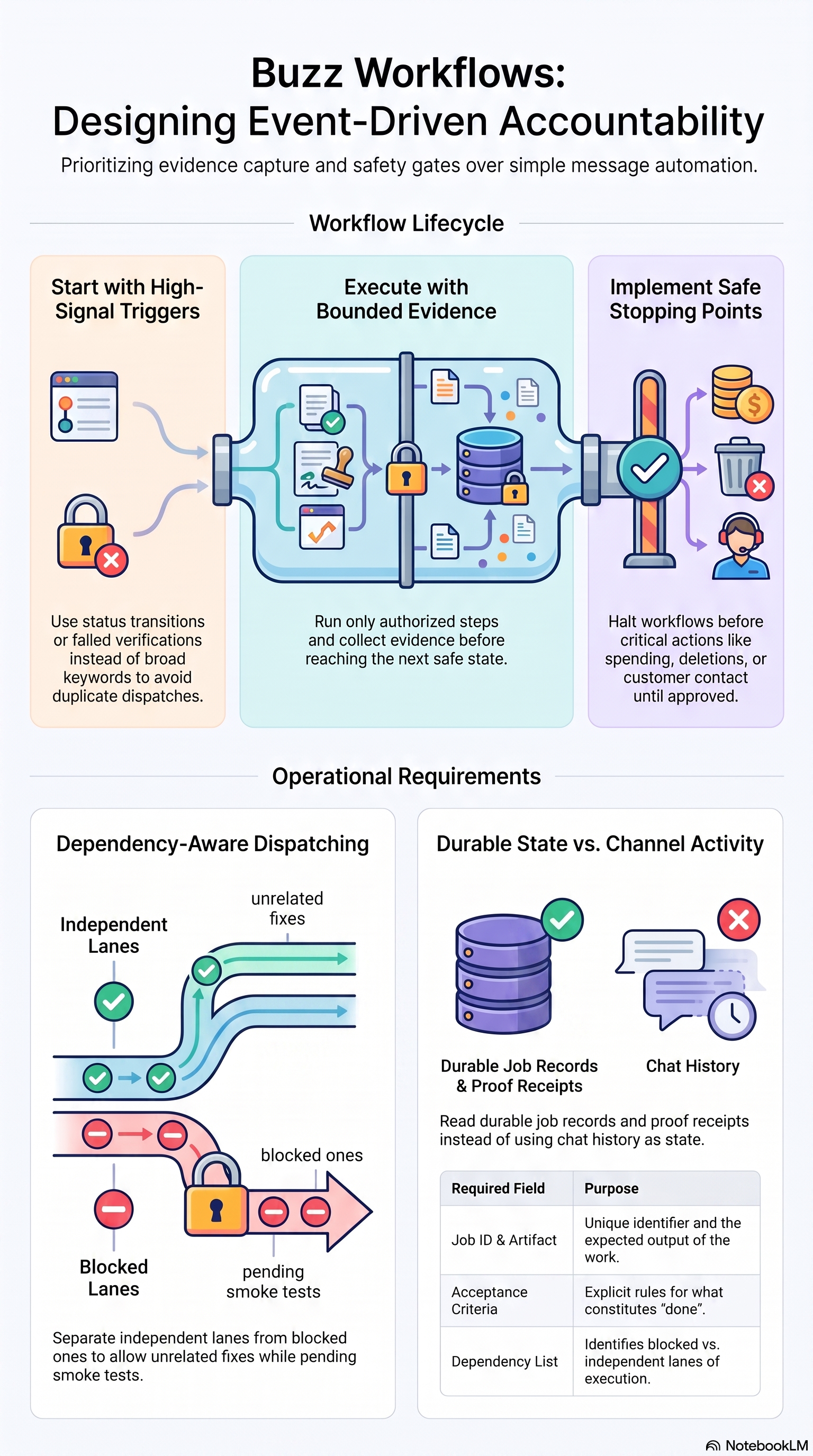
Agent systems drift when nobody can say what the job is, where the workflow should stop, what artifact proves completion, or who owns the failure when the chain breaks. They burn tokens when the loop keeps retrying, summarizing, or routing without a durable state check. They stop working when a runtime fails silently, a permission expires, or the owner becomes the manual fallback for every edge case.
How to read the evidence
Evidence level — documented operating pattern: the drift, retry, and silent-failure examples describe conditions this operating model is designed to detect. They do not state how often those failures occur across the market.
Evidence level — causal explanation: the token-waste discussion identifies mechanisms such as repeated work without a durable state check. It does not claim a measured savings percentage or guaranteed cost reduction.
Evidence level — delivery control: bounded workflows, owner gates, receipts, rollback read-back, and stabilization are controls included in the delivery model. Their result still has to be proved for each installation with its own acceptance receipts.
How drift starts
Drift starts when agents have broad goals instead of bounded jobs. A workflow says 'follow up with leads' but never defines timing, stop rules, owner review, or what counts as success.
The agent then invents policy at runtime. That is how teams end up with duplicate work, side effects nobody approved, and a lot of activity that nobody can verify afterward.
How token burn starts
Token burn usually comes from loops that do not read state before acting: repeated retries, repeated summaries, repeated routing, or repeated work on the same blocked step.
A healthy workflow reads the durable job record first. If the work is already done, already blocked, or still waiting on an owner gate, it does not keep spending tokens to rediscover that fact.
How systems stop working
Silent failure happens when there is no heartbeat, no attributable receipt, or no clear owner for the next action. The workflow dies, the queue stalls, and the owner only discovers it after a customer or task goes cold.
This is why proof is operational, not decorative. A visible success card without a fresh artifact or read-back is not enough.
What we control instead
We bound the workflow first: one job, one accountable owner, one authority model, one proof contract, and one public offer. Consequential steps stop at owner gates, and every accepted action has a receipt attached.
Then we stabilize. The current Founder Install includes the approved Blueprint, the minimum workforce, acceptance tests, rollback-safe read-back, and a 14-day window to fix failures before handoff.
Related guides
FAQ
Why do Buzz agents drift?
Because the workflow, authority boundary, proof requirement, or stop rule is not explicit enough for the agent system to stay aligned under load.
What causes most token burn?
Repeated work without a durable state read: retries, summaries, dispatches, and loops that keep spending tokens even though the workflow is already blocked or complete.
How do you control silent failures?
Heartbeats, owner gates, receipts, rollback-safe read-back, and a stabilization window make failures attributable instead of invisible.
Grounded media package